How Artificial Intelligence Is Making Human Security Guards More Essential Than Ever
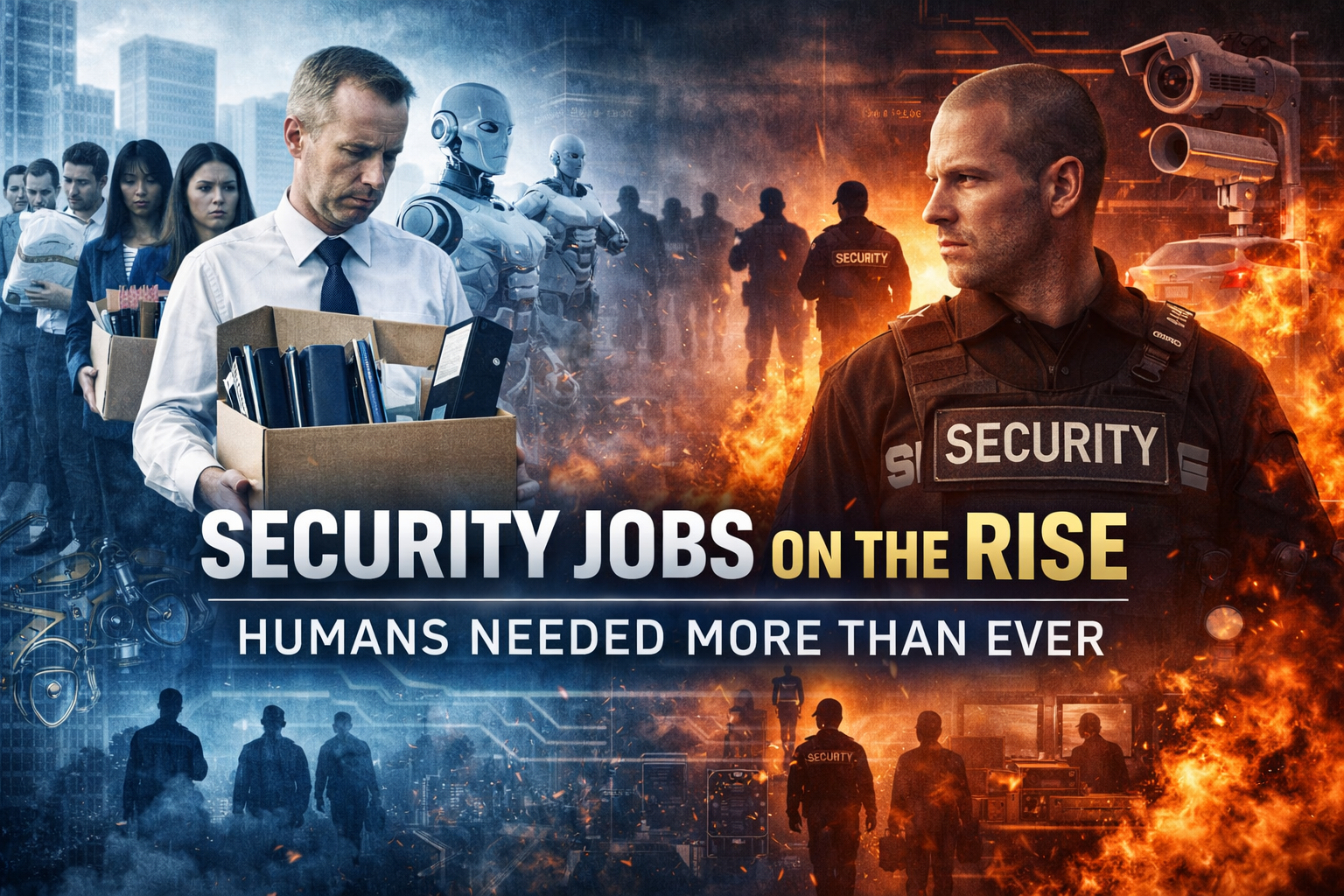
Artificial intelligence (AI) is transforming almost every industry, automating tasks that used to belong exclusively to people and reshaping the global job market. According to Goldman Sachs Research, shifts driven by AI could expose the equivalent of 300 million jobs worldwide to automation over the coming decade. Similar analysis summarized by the BBC notes that AI could replace a quarter of work tasks in the US and Europe, even as it creates new kinds of work.
Research from MIT Sloan shows that firms using AI extensively tend to be larger, more productive, and grow faster than their competitors, which changes the mix of jobs and skills they need. In some roles, AI reduces the number of workers required; in others, it boosts employment because people can focus on tasks where human judgment still matters most. Either way, AI is intensifying economic pressure and helping drive a major reallocation of labor and investment across the economy.
As organizations pour more money into software, robotics, and intelligent systems, their exposure grows: high‑value servers, automation equipment, and AI infrastructure all become critical assets that must be protected in the physical world. Market analysts at Fortune Business Insights and Grand View Research project that the global physical security market (cameras, access control, alarm systems, and related technologies) will expand well past $150 billion in annual spending by 2030. At the same time, the private security services market is expected to grow from about $5.0 billion in 2025 to $8.0 billion by 2030, a compound annual growth rate of 9.8%.
Another Grand View Research outlook for North America private security services shows the regional market rising from roughly $2.7 billion in 2024 to $4.6 billion by 2030, with integrated security systems as the fastest‑growing segment. These numbers confirm what security professionals already see on the ground: as companies invest heavily in technology, they simultaneously increase the value—and vulnerability—of the assets that must be guarded.
AI can monitor video feeds, analyze patterns, and trigger real‑time alerts, but it cannot physically intervene, de‑escalate conflicts, or read the full human context of a high‑stress situation. Industry discussions, such as those from security integrators and AI‑video providers, point out that relying on humans to stare at screens is not enough; after as little as 20 minutes of continuous monitoring, people can miss the vast majority of activity. AI‑assisted systems help by flagging what matters—but trained security guards are still the ones who respond, assess, and take action.
For businesses, this means that as they redirect budgets away from some traditional labor costs and into AI, machinery, and data‑center infrastructure, they also increase their need for professional manned security. The technology itself—robots, automation lines, data centers, specialized servers—becomes a high‑value target for theft, sabotage, and social engineering. A single incident against these assets can shut down operations, damage brand reputation, and wipe out years of technology investment.
At Guards Institute, we believe the security industry is entering a long‑term boom driven by this exact dynamic: AI reshapes the workforce, but it also creates new, higher‑stakes assets that must be preserved by trained security professionals. Our mission is to prepare security guards who understand both traditional protection principles and how to operate alongside advanced surveillance systems, sensors, and AI analytics. In a world where automation is everywhere and economic uncertainty is rising, the visible presence of a skilled guard provides something algorithms cannot deliver—human judgment, calm under pressure, and a trusted, physical line of defense for people, property, and technology.